
What Leviticus 23 commands
The Feast of Tabernacles began on the 15th day of the seventh month (Tishri, in September or October), five days after the Day of Atonement. It lasted seven days, followed by a special eighth day of rest and gathering (Leviticus 23:34-36, 39).
God gave Israel these instructions:
- Rest: The first day and the eighth day were holy days of rest.
- Celebrate with branches: "You shall take on the first day the fruit of splendid trees, branches of palm trees and boughs of leafy trees and willows of the brook, and you shall rejoice before the LORD your God seven days" (23:40).
- Live in booths: "You shall dwell in booths for seven days... that your generations may know that I made the people of Israel dwell in booths when I brought them out of the land of Egypt" (23:42-43).
Deuteronomy adds that it was to be the most joyful of feasts, including everyone, from servants to foreigners, widows, and orphans: "You shall rejoice in your feast" (Deuteronomy 16:13-15). Every seventh year, the law was to be read aloud to the whole people during this feast (Deuteronomy 31:10-13).
Remembering the wilderness
The booths (sukkot, singular sukkah) were simple shelters made of branches. Living in them for a week reminded each generation of Israel's forty years in the wilderness, when they had no permanent homes, but God provided manna, water, guidance, and his presence in the pillar of cloud and fire.
The timing was meaningful. The feast came at the end of the harvest, when barns were full. Just when Israel might feel most self-sufficient, God told them to move out of their solid houses and remember that they had always depended on him.
The feast in Israel's history
The Feast of Tabernacles appears at key moments in Israel's story:
- Solomon's temple: Solomon dedicated the temple during the feast of the seventh month, and God's glory filled the house (1 Kings 8:2, 10-11; 2 Chronicles 5:3, 13-14).
- After the exile: When the exiles returned to Jerusalem, Ezra read the law, and the people rediscovered the command to live in booths. They celebrated with "very great rejoicing" (Nehemiah 8:13-18).
- The prophets' hope: Zechariah pictures a future when the nations will come to Jerusalem "year after year to worship the King, the LORD of hosts, and to keep the Feast of Booths" (Zechariah 14:16).
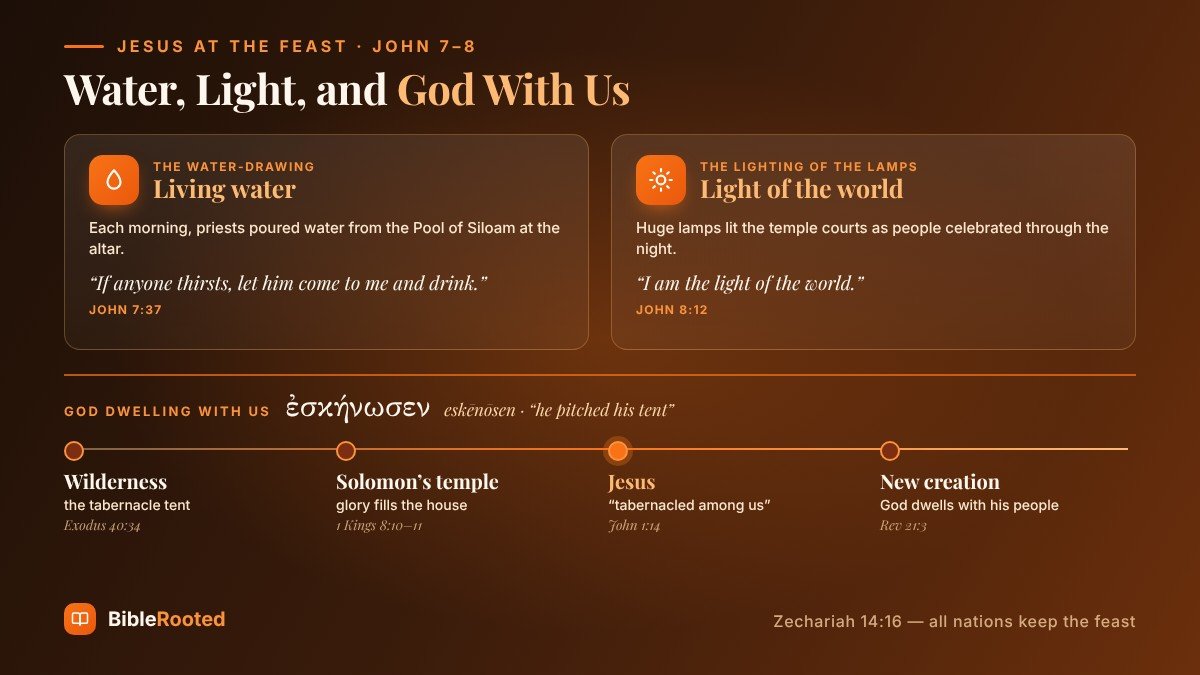
Water and light: Jesus at the feast
By Jesus's time, two famous ceremonies were part of the festival in the Jerusalem temple, according to later Jewish sources (the Mishnah, tractate Sukkah):
- The water-drawing ceremony: Each morning, priests drew water from the Pool of Siloam and poured it out at the altar, praying for rain and recalling God's promises of living water.
- The lighting of the lamps: Huge lamps were lit in the temple's Court of the Women, and people danced and celebrated through the night.
John 7–8 places Jesus right in the middle of this festival. "On the last day of the feast, the great day, Jesus stood up and cried out, 'If anyone thirsts, let him come to me and drink. Whoever believes in me, as the Scripture has said, "Out of his heart will flow rivers of living water"'" (John 7:37-38). John explains that he was speaking of the Spirit (7:39).
Soon afterward, Jesus says, "I am the light of the world. Whoever follows me will not walk in darkness" (John 8:12).
Against the backdrop of the water and light ceremonies, Jesus claims to be what the feast celebrated: the source of life-giving water and the light of God's presence.
"He tabernacled among us"
John's Gospel opens with a phrase that connects directly to this feast: "The Word became flesh and dwelt among us" (John 1:14). The Greek verb eskēnōsen literally means "pitched his tent" or "tabernacled."
The image recalls the tabernacle in the wilderness, the tent where God's glory dwelt among Israel. John says that in Jesus, God has come to live among his people in a new way: "We have seen his glory" (1:14).
The feast's final fulfillment
Revelation completes the picture. In the new creation, a loud voice announces, "Behold, the dwelling place [skēnē, tent] of God is with man. He will dwell [skēnōsei, tabernacle] with them, and they will be his people" (Revelation 21:3). The great multitude in Revelation 7 even stands before the throne holding palm branches (7:9), a Tabernacles image, and God promises to "shelter them with his presence" (7:15).
The Feast of Tabernacles, then, looks back to the wilderness and forward to the day when God's temporary dwelling among his people becomes permanent.
Frequently asked questions
When is the Feast of Tabernacles?
It begins on the 15th of Tishri in the Hebrew calendar, which usually falls in late September or October. Because the Hebrew calendar is lunar, the date changes each year on the modern calendar.
What is a sukkah?
A sukkah is a temporary hut or booth made with branches or other natural materials, with a roof open enough to see the sky. Jewish families today still build them and eat meals in them during Sukkot.
Do Christians celebrate the Feast of Tabernacles?
Most Christian traditions don't observe it as a required feast, since the New Testament treats the feasts as "a shadow of the things to come" fulfilled in Christ (Colossians 2:16-17). Some Christians celebrate it as a way to learn about Jesus's Jewish context and the hope of God dwelling with his people.
What is the difference between the tabernacle and the Feast of Tabernacles?
The tabernacle was the portable tent sanctuary where God's presence dwelt among Israel (Exodus 25–40). The Feast of Tabernacles is the festival when Israelites lived in booths. Both share the theme of God's presence with his people on the journey.