
Two ways to translate the Bible
Every translation has to bridge a gap between ancient languages and modern English. Hebrew and Greek have different grammar, idioms, and word ranges than English, so translators must make choices. Broadly, there are two approaches.
Formal equivalence ("word-for-word"). This approach tries to keep the original words, word order, and grammatical structure as closely as possible while still producing readable English. It lets you see more of the original's features, but it can sound stiff.
Dynamic or functional equivalence ("thought-for-thought"). This approach focuses on conveying the original meaning in natural, modern English, even if that means restructuring sentences or using different words. It reads smoothly but involves more interpretive choices by translators.
No translation is purely one or the other. Every translation sits somewhere on a spectrum between them.
More literal ←——————————————————————————→ More readable
 ESV NIV NLT
Neither approach is "better." They serve different purposes. For a deeper look at this question, see Does a "Most-Accurate" Bible Translation Exist?
The ESV (English Standard Version)
- First published: 2001, with later light revisions.
- Approach: "Essentially literal," formal equivalence.
- Background: A revision of the Revised Standard Version (RSV), continuing the tradition of the King James Version.
Strengths:
- Keeps key repeated words consistent, which helps you trace themes and wordplay.
- Preserves more of the original sentence structure and imagery.
- Good for memorization, close study, and teaching.
Trade-offs:
- Can sound formal or awkward in places.
- Long Pauline sentences can be harder to follow.
Best for: Readers who want to study closely, do word studies, or compare with the original languages.
The NIV (New International Version)
- First published: 1978 (New Testament in 1973), with major updates in 1984 and 2011.
- Approach: A balance between formal and dynamic equivalence.
- Background: Translated by an international, multi-denominational team of scholars.
Strengths:
- Clear, natural English that still stays close to the original.
- Works well for both reading and study.
- One of the most widely used English translations, so it's common in churches and study materials.
Trade-offs:
- More interpretive than the ESV in places.
- The 2011 update uses more gender-inclusive language for people (e.g., "brothers and sisters" where the context includes everyone), which some readers appreciate and others debate.
Best for: Readers who want one translation that works for everyday reading and personal study.
The NLT (New Living Translation)
- First published: 1996, with later revisions.
- Approach: Dynamic equivalence, thought-for-thought.
- Background: Began as a revision of The Living Bible (1971), a paraphrase, but was redone as a true translation from Hebrew and Greek by a team of scholars.
Strengths:
- Very easy to read, even for young readers or people new to the Bible.
- Excellent for reading long sections, like whole books in one sitting.
- Often makes the meaning of difficult idioms immediately clear.
Trade-offs:
- Makes more interpretive decisions for you.
- Repeated Hebrew or Greek words may be translated differently in different places, making it harder to trace themes.
Best for: First-time readers, devotional reading, reading aloud, and reading large portions quickly.
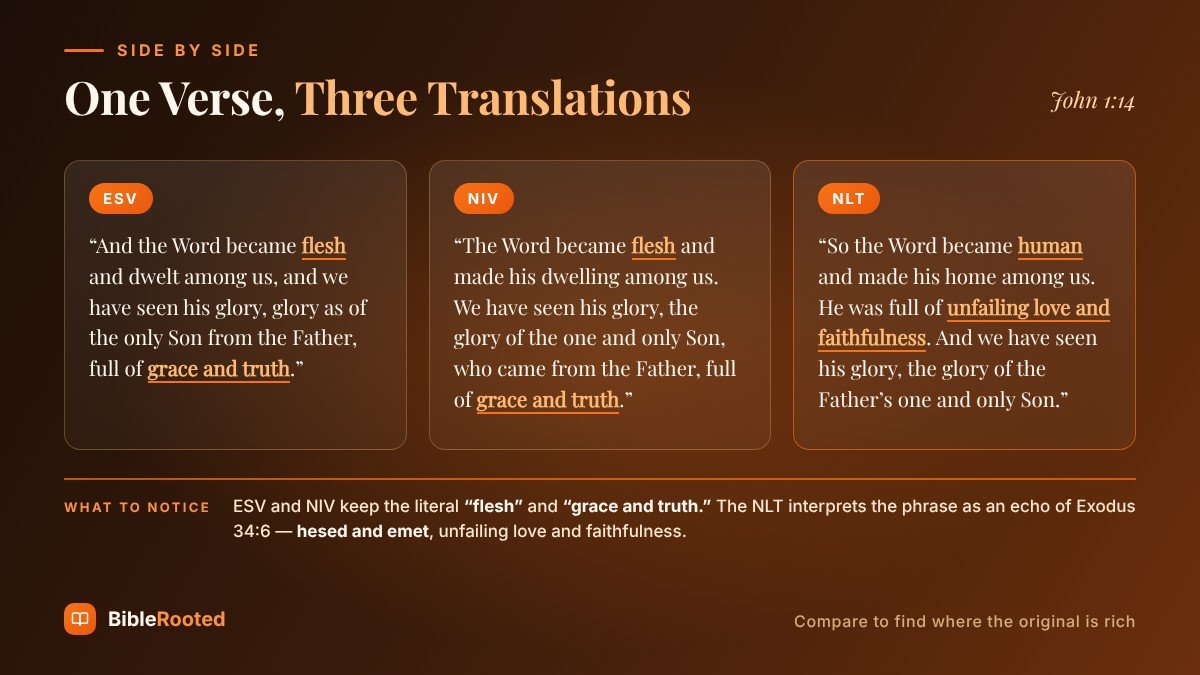
Side by side: three verses compared
Seeing the same verse in all three translations is the best way to understand the difference.
John 1:14
- ESV: "And the Word became flesh and dwelt among us, and we have seen his glory, glory as of the only Son from the Father, full of grace and truth."
- NIV: "The Word became flesh and made his dwelling among us. We have seen his glory, the glory of the one and only Son, who came from the Father, full of grace and truth."
- NLT: "So the Word became human and made his home among us. He was full of unfailing love and faithfulness. And we have seen his glory, the glory of the Father's one and only Son."
What to notice: The ESV and NIV keep "flesh" and "grace and truth," the literal wording. The NLT says "unfailing love and faithfulness," which interprets the phrase as an echo of God's character in Exodus 34:6 (where the Hebrew words are hesed and emet). It's a meaningful insight, but it's the translator's interpretation, not the literal wording. (See What Does Hesed Mean?)
Romans 8:5
- ESV: "For those who live according to the flesh set their minds on the things of the flesh, but those who live according to the Spirit set their minds on the things of the Spirit."
- NIV: "Those who live according to the flesh have their minds set on what the flesh desires; but those who live in accordance with the Spirit have their minds set on what the Spirit desires."
- NLT: "Those who are dominated by the sinful nature think about sinful things, but those who are controlled by the Holy Spirit think about things that please the Spirit."
What to notice: Paul's Greek word sarx literally means "flesh." The ESV and NIV keep it. The NLT explains it as "sinful nature," which clarifies Paul's point but removes the word that connects to many other passages.
Romans 12:1
- ESV: "I appeal to you therefore, brothers, by the mercies of God, to present your bodies as a living sacrifice, holy and acceptable to God, which is your spiritual worship."
- NIV: "Therefore, I urge you, brothers and sisters, in view of God's mercy, to offer your bodies as a living sacrifice, holy and pleasing to God—this is your true and proper worship."
- NLT: "And so, dear brothers and sisters, I plead with you to give your bodies to God because of all he has done for you. Let them be a living and holy sacrifice—the kind he will find acceptable. This is truly the way to worship him."
What to notice: The Greek word behind "spiritual" / "true and proper" / "truly" (logikēn) is genuinely hard to translate. Each version makes a different choice, which shows why comparing translations can be so helpful.
Comparison table
| ESV | NIV | NLT | |
|---|---|---|---|
| Approach | Word-for-word | Balanced | Thought-for-thought |
| Readability | Moderate | High | Very high |
| Best for | Close study, memorization | Everyday reading and study | First-time readers, devotional, reading aloud |
| Tracing key words | Easiest | Moderate | Hardest |
| Interpretive choices | Fewest | Moderate | Most |
| Gender language for people | Traditional ("brothers") | Inclusive where meaning includes all ("brothers and sisters") | Inclusive |
Other translations worth knowing
The ESV, NIV, and NLT aren't your only good options. Here's where some other popular translations fit on the spectrum.
- NASB (New American Standard Bible): One of the most literal English translations, first completed in 1971 and updated in 1995 and 2020. Excellent for detailed study, though it can read stiffly.
- KJV (King James Version): Published in 1611, the most influential English translation in history. Its formal, poetic language shaped English literature, but some of its words have changed meaning over 400 years.
- NKJV (New King James Version): A 1982 update of the KJV's language that keeps its traditional style and textual basis.
- CSB (Christian Standard Bible): Published in 2017 as a revision of the Holman Christian Standard Bible. Its translators describe its approach as "optimal equivalence," aiming for a balance similar to the NIV, but slightly more literal.
- NRSVue (New Revised Standard Version, Updated Edition): Released in 2021, a revision of the 1989 NRSV. It's widely used in academic settings and in mainline Protestant churches, and editions are available with the deuterocanonical books.
- The Message: Eugene Peterson's paraphrase (completed in 2002), which renders the Bible in vivid contemporary language. It's a paraphrase, not a translation in the strict sense, so it's best used alongside a translation, not instead of one.
Updated spectrum:
More literal ←——————————————————————————————————————→ More readable
 NASB ESV/NKJV/KJV NRSVue CSB NIV NLT The Message
(Placements are approximate. Translators disagree about exactly where each version belongs.)
So which translation should you choose?
- New to the Bible? Start with the NLT or NIV. You'll understand more and read further.
- Want one Bible for everything? The NIV is a strong all-purpose choice.
- Studying closely or teaching? Use the ESV (or another formal translation such as the NASB or CSB), and check a readable version alongside it.
- Reading whole books in one sitting? The NLT makes long reading easy and enjoyable.
The best approach for most people is to use two translations: one more literal and one more readable. When they differ, you've found a place where the original language is rich or complex, and that's often where the most interesting insights are.
Frequently asked questions
Which Bible translation is the most accurate?
"Accuracy" depends on what you mean. A word-for-word translation is accurate to the original form. A thought-for-thought translation aims to be accurate to the original meaning in natural English. All three of these are careful scholarly translations.
Is the NLT a paraphrase?
No. The NLT began as a revision of The Living Bible, which was a paraphrase, but the NLT itself was translated from the Hebrew and Greek texts by a large team of scholars. It's a dynamic-equivalence translation.
Is the ESV better than the NIV?
Neither is better overall. The ESV is better for tracing exact wording; the NIV is easier to read. Choose based on how you plan to use it.
What about the KJV?
The King James Version (1611) is beautiful and historically important, but its English is 400 years old, and modern translations are based on a larger number of ancient manuscripts discovered since then. Many people enjoy it alongside a modern translation.
Can I compare translations on Bible Rooted?
Yes. You can read the Bible on Bible Rooted in many versions and languages and switch between them chapter by chapter, which makes it easy to compare how different translations handle the same passage.